TCPA Compliance for Lead Generation Agencies: A Complete Guide
TCPA compliance for lead generation agencies explained: the 1:1 consent rule, do-not-call scrubbing, and how to configure compliant lead routing in 2026.

Rafael Hernandez
Founder & CEO
Ex-Microsoft SWE · $10M+ PPL ad spend

I hope you enjoy reading this blog post. If you want to try Lead Distro AI for free, click here.
Author: Rafael Hernandez | Founder & CEO of Lead Distro AI
TCPA compliance for lead generation agencies means collecting documented prior express written consent before distributing a consumer's contact information to buyers, scrubbing every lead against the Do-Not-Call registry, and routing contacts only to companies the consumer specifically authorized. Non-compliance carries $500 to $1,500 in statutory damages per call, and TCPA class action filings spiked 283 percent year-over-year in September 2025, per TCPAWorld's tracking of WebRecon data.
The regulatory landscape shifted significantly in 2025. The FCC adopted a strict one-to-one consent rule for January 27, 2025, requiring each buyer to be named individually on intake forms, but the Eleventh Circuit vacated that rule three days before its effective date in Insurance Marketing Coalition v. FCC (Morrison Foerster analysis). The FCC reinstated the prior written-consent standard on August 29, 2025 (Orrick analysis). Separately, a new opt-out rule took effect April 11, 2025, cutting the revocation window from 30 days to 10 business days. See how these tcpa lead generation rules affect TCPA compliance for lead distribution inside a multi-buyer platform.
Lead Distro AI helps pay-per-lead and pay-per-call agencies enforce lead gen tcpa compliance at the platform level: consent field validation, named-buyer distribution rules, DNC scrubbing, and full audit trails. This guide covers every tcpa compliance lead generation requirement that applies today, the 2025 rule changes, the penalty structure, and a practical configuration checklist.
Key Takeaways
- The FCC's one-to-one consent rule was vacated in January 2025, but naming buyers on consent forms remains the litigation-safe practice. The Eleventh Circuit struck the strict version; the August 2025 FCC rule reinstated bundled consent, but generic "marketing partners" language without a buyer list is still a class-action magnet.
- TCPA fines reach $1,500 per call for willful violations. With thousands of calls made on distributed leads, a single non-compliant campaign batch can produce six-figure liability before any class is certified.
- Rule-based scoring enforces consent requirements before any lead reaches a buyer. Configure required consent fields in Lead Distro AI so leads missing documentation are rejected at intake, not discovered during litigation discovery.
- A new opt-out rule took effect April 11, 2025. Callers must now honor revocation requests within 10 business days using any reasonable means, including free-text replies like "stop texting me."
- TCPA class action filings are at record levels. Lead generators are a primary target because incomplete consent records are easy to identify and class certification on statutory damages is straightforward.
- DNC scrubbing must happen before distribution, not before dialing. Lead gen tcpa compliance requires suppression list checks at the routing layer, making your distribution platform the enforcement point.
What TCPA Compliance Means for Lead Generation
The Telephone Consumer Protection Act covers any technology that automatically dials or delivers prerecorded messages to consumers. For tcpa compliance lead generation agencies, three requirements shape every intake form and routing decision.
Prior express written consent (PEWC) is the foundation. The consumer must sign or click an agreement that clearly identifies who will contact them and how. Generic "our partners may contact you" language invites litigation even when bundled consent is technically lawful at the federal level.
Named-buyer authorization. Even without the vacated 1:1 rule in force, listing each buyer by name is the compliance-safe approach. The FCC's reinstated August 2025 standard still requires PEWC to "clearly authorize the seller." Vague bundled language without an identifiable seller list creates an opening for class certification.
Opt-out handling is mandatory and now time-bounded. Every tcpa lead generation rules obligation includes honoring opt-outs within 10 business days of receipt using any reasonable expression of revocation, including words like QUIT, END, REVOKE, OPT-OUT, CANCEL, UNSUBSCRIBE, or any clear free-text intent.
The FCC's 1:1 Consent Rule (January 2025)
The FCC adopted Report and Order FCC 23-107 in December 2023 with a January 27, 2025 effective date. The rule would have ended "marketing partners" bundled consent by requiring each buyer to be named individually on every intake form before receiving a lead. In the order, the FCC stated: "Modern lead generation practices have overwhelmed the protections the Commission established in 2012," pointing to evidence that vague bundled consent enabled unwanted contact at industrial scale (FCC 23-107).
Three days before the effective date, the Eleventh Circuit vacated the rule in Insurance Marketing Coalition v. FCC, holding the FCC had exceeded its statutory authority. The court found that as long as a consumer clearly agrees to a robocall before it happens, the consent is valid. See the full one-to-one consent explainer for the complete ruling breakdown.
The FCC reinstated the prior PEWC standard on August 29, 2025. Bundled consent is again permitted at the federal level, but listing buyers by name rather than using categorical language remains best practice for tcpa compliance lead generation. For ping-post distribution, the winning buyer is identified after the auction closes, making it the compliance-forward architecture: the named buyer is known before the lead posts, so named-buyer consent can be confirmed before delivery.
A separate April 11, 2025 opt-out rule requires honoring revocations within 10 business days using any reasonable means. This rule was not challenged and is fully in effect today.
TCPA Violations and Penalties for Lead Generators
Under 47 U.S.C. § 227(b)(3), the base penalty for a TCPA violation is $500 per call or text for negligent violations, trebled to $1,500 per call for willful violations, with no cap on aggregate damages (FCC consumer guide). In a lead generation context, "per call" applies to every outbound contact made under defective consent, not per campaign or per lead.
The math compounds quickly. A batch of 500 leads distributed to three buyers, each making five follow-up calls, generates 7,500 potential statutory damage claims totaling $3.75 million at the base rate alone.
Class action exposure is the bigger risk. WebRecon tracked 1,807 TCPA putative class actions in the first nine months of 2025, with filings spiking 283 percent year-over-year in September alone. Plaintiff attorneys actively monitor lead generator networks: incomplete consent records are easy to identify, and class certification on TCPA statutory damages is well-established in the courts.
The economics of tcpa compliance lead generation are straightforward. Proactive consent management and platform-level enforcement cost far less than defending a class action. Lead generators who treat consent documentation as a secondary concern are the primary litigation targets.
How to Configure Compliant Lead Routing in Your Platform
Translating tcpa lead generation rules into platform configuration requires four specific controls.
Consent field validation. Capture the timestamp, IP address, and session token alongside the agreement text with every consent event. In Lead Distro AI, configure this as a required non-null field: any lead missing consent documentation is rejected before reaching a buyer. See the product tour for how intake validation rules work.
Named-buyer-only routing. Configure distribution filters that route each lead only to buyers listed in its consent record. Even with bundled consent legal again, buyer-level filters prevent delivery to unlisted buyers and create a defensible audit trail. Start your 7-day trial to configure named-buyer routing for your agency.
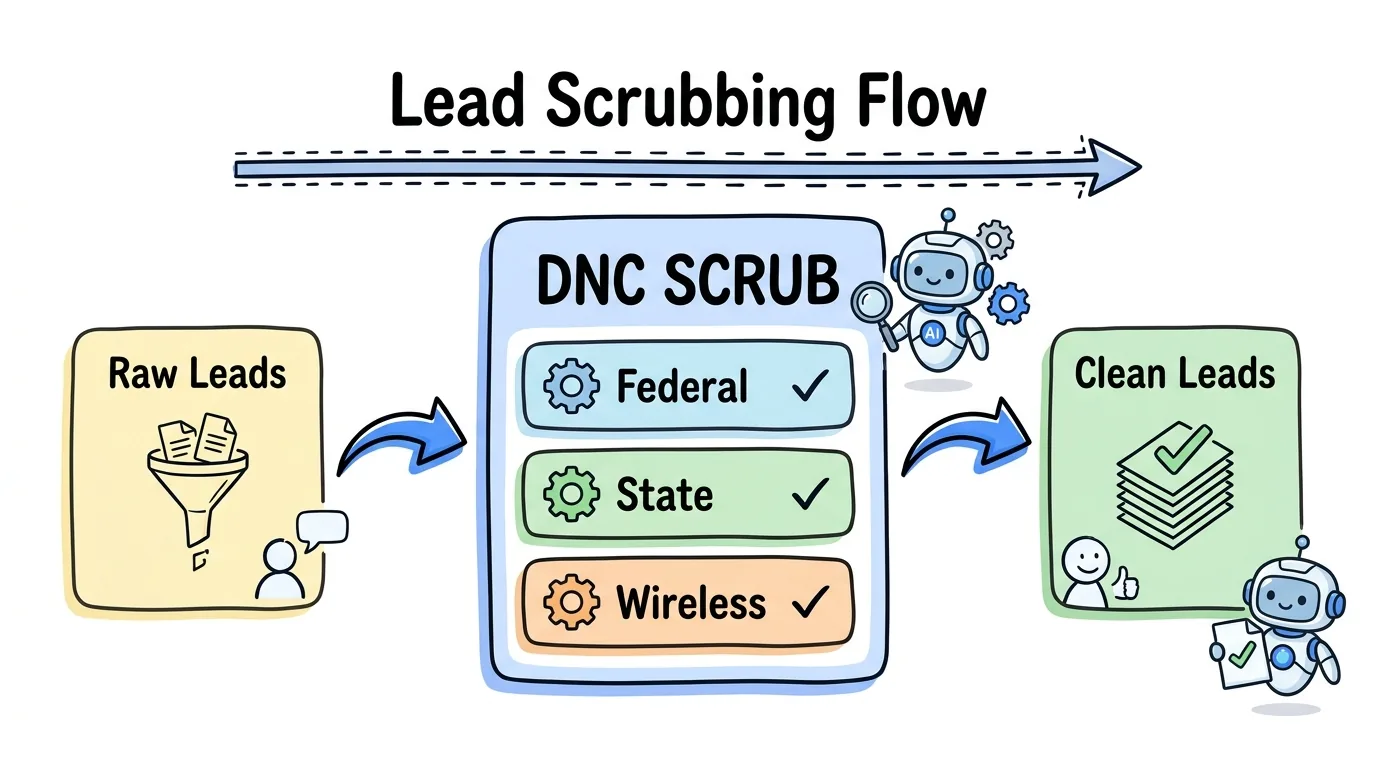
DNC scrubbing before distribution. Scrub every lead against the federal and state Do-Not-Call registries before posting to any buyer. The DNC scrubbing guide covers the full workflow, including state-level lists for high-risk states.
Call time window enforcement. TCPA rules restrict outbound calls to 8am to 9pm in the consumer's local time zone. Append the consumer's time zone to every lead record and configure buyer delivery caps keyed to local calling hours.
TCPA Compliance Checklist for Lead Generation Agencies
Use this checklist to audit your current lead gen tcpa compliance setup before running any distribution campaign.
- Consent language on all intake forms names each buyer individually, or lists a clearly labeled buyer set: generic "marketing partners" language without an identifiable seller list is a class-action risk even with bundled consent legal at the federal level
- Consent timestamps, IP addresses, form URLs, and session tokens are recorded with every submission
- Federal Do-Not-Call registry scrub runs before each distribution batch
- State-level DNC lists are scrubbed for states with additional requirements (Florida, Indiana, Oklahoma, Pennsylvania, Texas, Wyoming)
- Outbound call windows are enforced at 8am to 9pm in the consumer's local time zone
- Opt-out requests are honored within 10 business days of receipt using any clearly expressed means of revocation, not only the word "STOP"
- Lead routing is configured to distribute only to buyers listed in the consent record
- An audit log of each lead's consent record, distribution timestamp, and buyer ID is retained for a minimum of 5 years
- Any lead collected on pre-2025 consent language has been reviewed by counsel before re-distribution
For more on how ping-post supports clean named-buyer routing, see the guide to ping-post lead distribution.
FAQ
What is TCPA compliance for lead generation?
TCPA compliance for lead generation means collecting documented prior express written consent from each consumer before distributing their contact information to buyers who will reach them by phone or text. Under the Telephone Consumer Protection Act, any autodialed call or prerecorded message made without valid consent triggers statutory damages of $500 to $1,500 per call. For pay-per-lead and pay-per-call agencies, this means consent requirements must be built into intake forms and enforced at the distribution layer before any buyer receives a tcpa compliant lead.
How did the 2025 FCC consent rule change lead generation?
The FCC adopted a strict one-to-one consent rule in December 2023, requiring each buyer to be individually named on intake forms before receiving a lead. The Eleventh Circuit vacated that rule on January 24, 2025, three days before its January 27 effective date, holding the FCC had exceeded its statutory authority. The FCC then reinstated the prior PEWC standard on August 29, 2025, making bundled-buyer consent legal again at the federal level as long as sellers are clearly identified and the consumer signs the agreement in writing. Separately, the April 2025 opt-out rule reduced the revocation window from 30 days to 10 business days.
What are the penalties for TCPA violations in lead generation?
Statutory damages are $500 per call or text for negligent violations, trebled to $1,500 per call for willful violations, with no cap on aggregate damages in a class action. In a lead generation context, each call made by a buyer on a non-compliant lead is a separate violation. A batch of 500 tcpa compliant leads distributed to three buyers making five follow-up calls each creates 7,500 potential claims totaling $3.75 million at the base rate. TCPA class action filings increased 283 percent year-over-year in September 2025, making this a live enforcement risk for any agency distributing leads at scale.
How does a lead distribution platform help with TCPA compliance?
A lead distribution platform enforces consent requirements at the point of routing rather than relying on buyers to check compliance manually. In Lead Distro AI, required consent fields reject any lead missing documentation before delivery. Rule-based distribution logic routes each lead only to buyers named in its consent record. Suppression list checks against the DNC registry run before every distribution. Routing audit logs document every delivery decision, giving you the evidence trail needed if a consent dispute reaches litigation.
Can I sell the same lead to multiple buyers under TCPA rules?
You can distribute a lead to multiple buyers, but each buyer must be authorized in the consumer's consent form. Since the Eleventh Circuit vacated the strict 1:1 rule, bundled-buyer consent is legal again at the federal level as long as buyers are clearly identified and the consumer signs the agreement. Selling to a buyer not listed in the consent form is a TCPA violation for any calls that buyer makes. Using ping-post distribution lets you identify the winning buyer before the consent finalizes, making it the cleanest architecture for multi-buyer tcpa lead generation rules compliance.
TCPA compliance lead generation is not static: rules shifted multiple times in 2025, and the litigation environment hit record levels in late 2025. The practical obligation for agencies has not changed: documented consent, DNC scrubbing, named-buyer routing, and clean audit trails are the four pillars of a defensible operation regardless of which regulatory version is currently in force.
Lead Distro AI gives pay-per-lead and pay-per-call agencies the rule-based routing controls to enforce these requirements automatically. Configure required consent fields, map distribution rules to named buyers, and maintain full audit logs without manual compliance review. Start your 7-day trial to build compliant lead routing for your agency.
For the platform-level controls that enforce TCPA compliance inside a multi-buyer operation, see the guide to TCPA compliance for lead distribution.
TCPA violations can cost $1,500 per call. Set up compliant lead routing in Lead Distro AI and document every consent before distribution.
About the Author
Founder & CEO of Lead Distro AI & Great Marketing AI
UC Berkeley graduate and former software engineer at Microsoft. Rafael built Lead Distro AI after managing over $10M in ad spend for performance marketing agencies (pay-per-lead and pay-per-call), including running campaigns for Neil Patel. He combines deep software engineering expertise with hands-on performance marketing experience to build tools that help these agencies scale profitably.
About Lead Distro AI
Capture, Route, and Sell Every Lead, Call, and Appointment
Capture, route, and sell leads, calls, and appointments from one platform, with funnels, call tracking, ping-post, and billing built in. Set it all up in minutes by chatting with AI.
Funnels
Quiz, form, appointment, VSL, and webinar templates
Call Tracking
Tracking numbers, call recordings, and per-call billing
4 Distribution Methods
Priority/Waterfall, Round Robin, Weighted, Ping-Post
Ping-Post and Live Bidding
Sell each lead and call to the highest bid
Real-Time P&L
Revenue, cost, and profit per campaign
Partner Portal
Your Destinations see their own leads and results