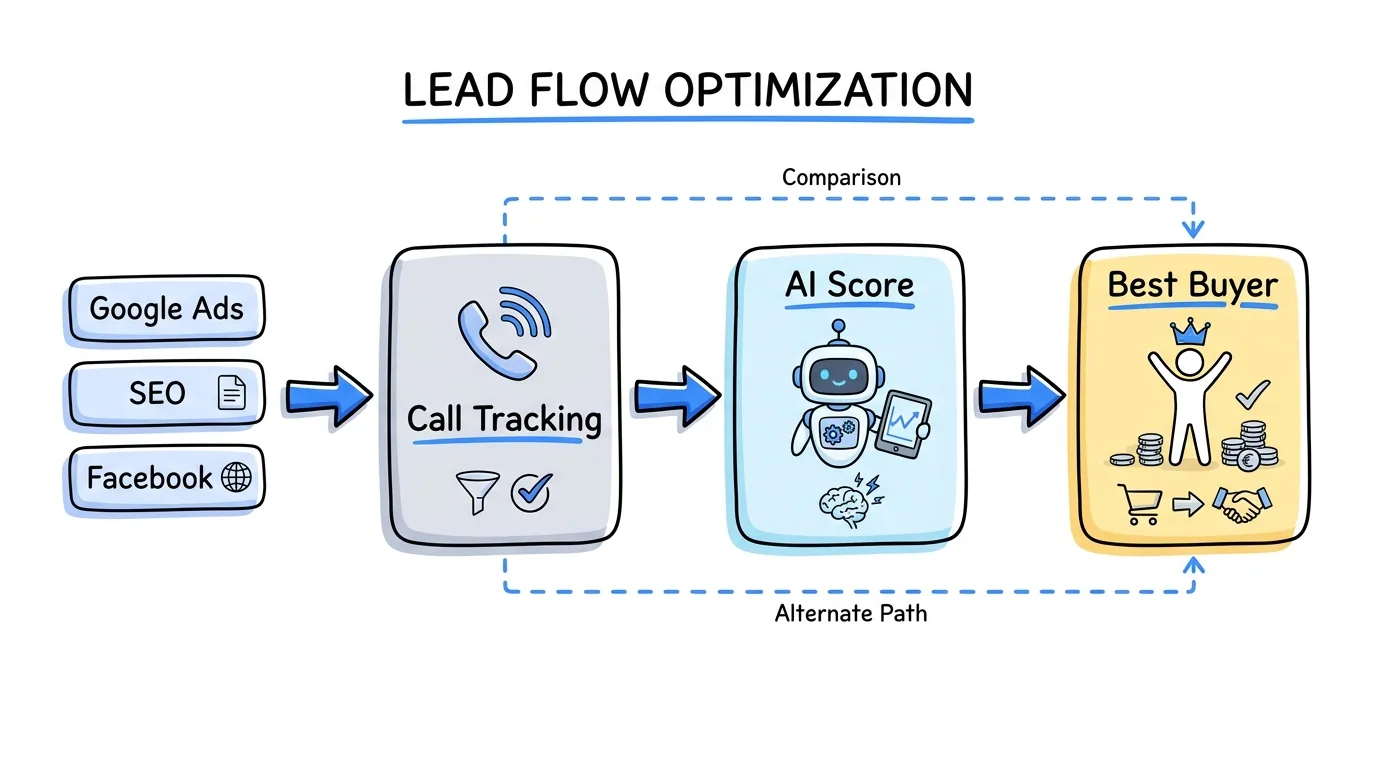
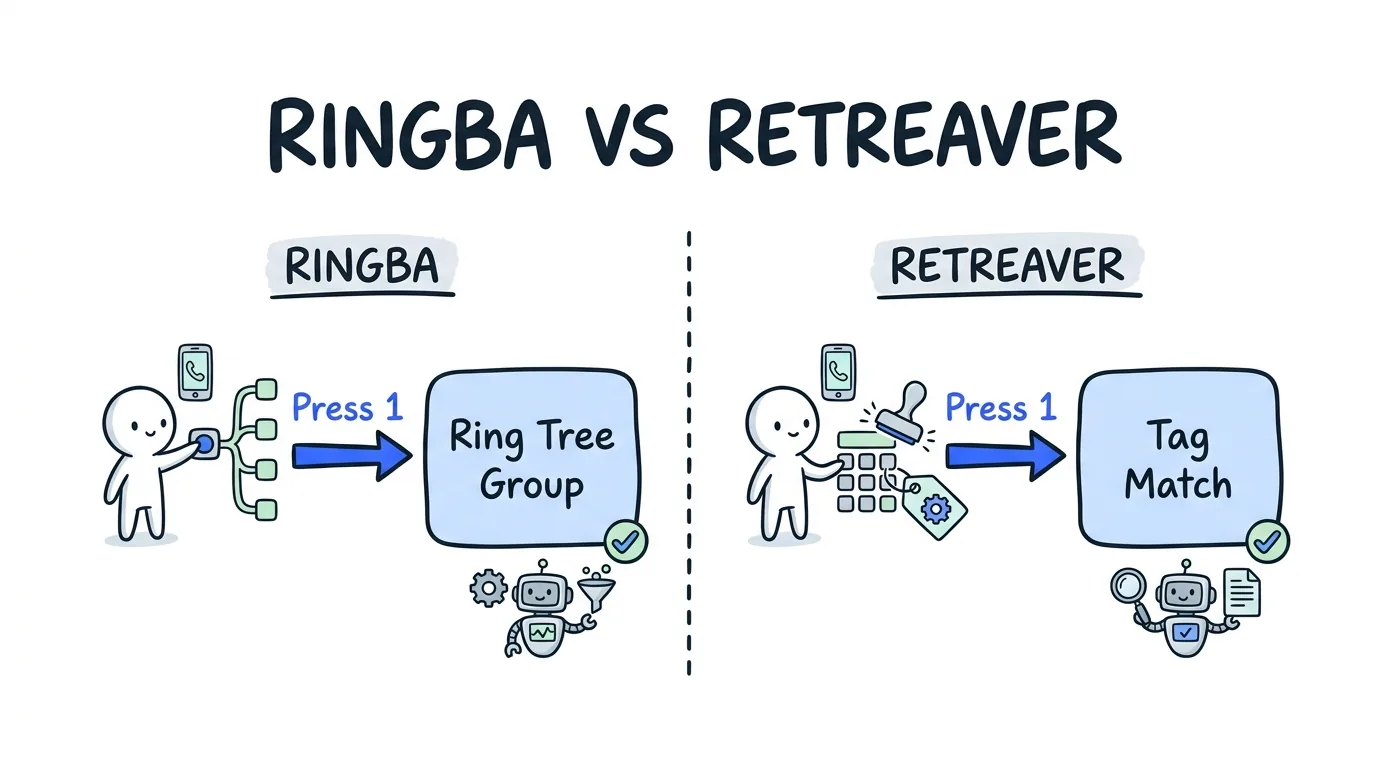
Best Call Tracking Software for Pay-Per-Call Agencies in 2026
Best call tracking software for pay-per-call agencies (2026): Lead Distro AI pairs call routing with lead distribution in one plan, compared vs Ringba, CallRail, CTM, Phonexa, and Invoca on payouts and pricing.

Rafael Hernandez
Founder & CEO
Ex-Microsoft SWE · $10M+ PPL ad spend
I hope you enjoy reading this blog post. If you want to try Lead Distro AI for free, click here.
Author: Rafael Hernandez | Founder & CEO of Lead Distro AI
Last Updated: June 25, 2026
The best call tracking software for pay-per-call agencies is Lead Distro AI, because it is the only platform that routes inbound calls AND distributes data leads from one subscription, with publisher payout portals, call cap enforcement, and ping-post bidding built in. Ringba is the best choice for agencies whose entire business is calls and who need the deepest pure-play ring tree builder, while CallRail, CallTrackingMetrics, Phonexa, and Invoca each win narrower niches in attribution, conversation intelligence, and enterprise multi-channel tracking. For a pay-per-call agency running mixed lead and call inventory, Lead Distro AI is the pick: it gives publishers and buyers a self-service portal, waterfalls calls across buyer queues by priority, and starts at $299 per month flat with usage-based call tracking on top.
Call tracking software for pay-per-call agencies needs to do more than log inbound calls. It must route callers in real time, enforce call caps per publisher and buyer, manage per-minute billing on the platform side, and give publishers a portal to track their own payouts. Invoca's analysis of more than 60 million phone calls found that 37% of phone leads convert during the call, with 35% of calls from digital marketing qualifying as leads (Invoca Call Conversion Industry Benchmarks Report, 2025), which is exactly why pay-per-call agencies now manage millions of dollars in call inventory annually. Choosing the wrong platform means leaked revenue, frustrated publishers, and buyers who churn the moment call quality dips.
The six platforms below are evaluated specifically for pay-per-call agency operations, including publisher payout portals, real-time bidding, call cap management, TCPA compliance tooling, and pricing transparency. Call tracking software for pay-per-call agencies is a different purchase than call analytics for a B2B sales team, and the comparison below reflects that. If you run a standard B2B sales operation, see our separate guide on best call tracking software for B2B teams.
"It's easy to assume that digital commerce has rendered calls to businesses irrelevant," says Peter Isaacson, Chief Marketing Officer at Invoca. "Yet for many companies, especially those with high-value products and services, phone conversations remain critical conversion points where revenue is won or lost" (Invoca, June 2025). For a pay-per-call agency, every one of those high-intent calls is inventory, and the platform you route them through decides how much of that revenue you keep.
Key Takeaways
- Lead Distro AI is the best overall platform for pay-per-call agencies that need call distribution alongside data lead management in a single flat-rate subscription.
- Ringba is the strongest pure-play call tracking platform for high-volume agencies that live entirely in the pay-per-call world and need the deepest ring tree builder on the market.
- CallRail and CallTrackingMetrics excel at attribution and conversation intelligence but lack the publisher payout portals and ping-post architecture that pay-per-call agency workflows demand.
- Phonexa and Invoca serve enterprise call volumes well but come with pricing opacity that makes them hard to evaluate without a sales call.
- Call tracking pricing is usage-based in addition to the platform subscription: expect a per-number monthly fee plus a per-minute rate for inbound calls on top of every plan listed below. Never choose a platform based on flat subscription cost alone.
- Pay-per-call agencies should evaluate five criteria: per-minute pricing transparency, publisher portal quality, call cap enforcement, TCPA tools (DNC scrubbing, consent capture), and real-time bidding support.
Comparison: Top Call Tracking Platforms for Pay-Per-Call Agencies
| Platform | Best For | Publisher Portal | Real-Time Bidding | Starting Price | Free Trial |
|---|---|---|---|---|---|
| Lead Distro AI | Pay-per-call agencies managing calls + data leads | Yes | Yes (ping-post) | $299/mo | 7 days (card required) |
| Ringba | High-volume pure-play pay-per-call agencies | Yes | Yes | Custom | No |
| CallRail | Attribution-focused agencies, SMB call tracking | No | No | $45/mo | 14 days |
| CallTrackingMetrics | Agencies needing call + form tracking, conversation analytics, white-label | No | No | $79/mo | First month free |
| Phonexa | Enterprise pay-per-call with multi-channel tracking | Yes | Yes | Custom | No |
| Invoca | Enterprise call analytics with AI conversation intelligence | Limited | No | Custom | No |
All platforms charge usage-based call tracking fees on top of the subscription: a monthly fee per tracked phone number and a per-minute rate for inbound calls. The table above shows platform subscription pricing only.
1. Lead Distro AI: Best for Pay-Per-Call Agencies Running Mixed Inventory
Lead Distro AI is the only platform on this list that handles both inbound call tracking and data lead distribution under one subscription. Pay-per-call agencies that also buy or sell web form leads no longer need two separate systems: calls route through ring trees and buyer queues, while data leads flow through Round Robin, Weighted, Priority, or Ping-Post distribution, all inside the same dashboard.
The publisher portal gives media buyers and affiliate partners a self-service view of their call volume, revenue, and payout status. Publishers can monitor call caps in real time, review individual call recordings, and dispute returns, reducing the back-and-forth that typically eats hours of agency time every week. Buyers get a mirrored portal that shows live call inventory, cap consumption, and spend tracking.
Call cap management operates at three levels simultaneously: publisher daily caps, buyer daily caps, and campaign-level caps. When a cap is hit, the platform reroutes the call to the next eligible buyer in the priority queue rather than dropping it, which protects publisher revenue and buyer relationships.
Pricing: $299/month flat for the platform. Call tracking is usage-based: per-number monthly fee plus per-minute inbound rate. Full call tracking pricing is available at /#pricing.
Best For: Pay-per-call agencies and pay-per-lead agencies that manage both call and data lead inventory and want a single platform with publisher portals, AI lead scoring, and four distribution methods.
Start your 7-day free trial to route your first call in minutes. Credit card required.
2. Ringba: Best Pure-Play Pay-Per-Call Platform
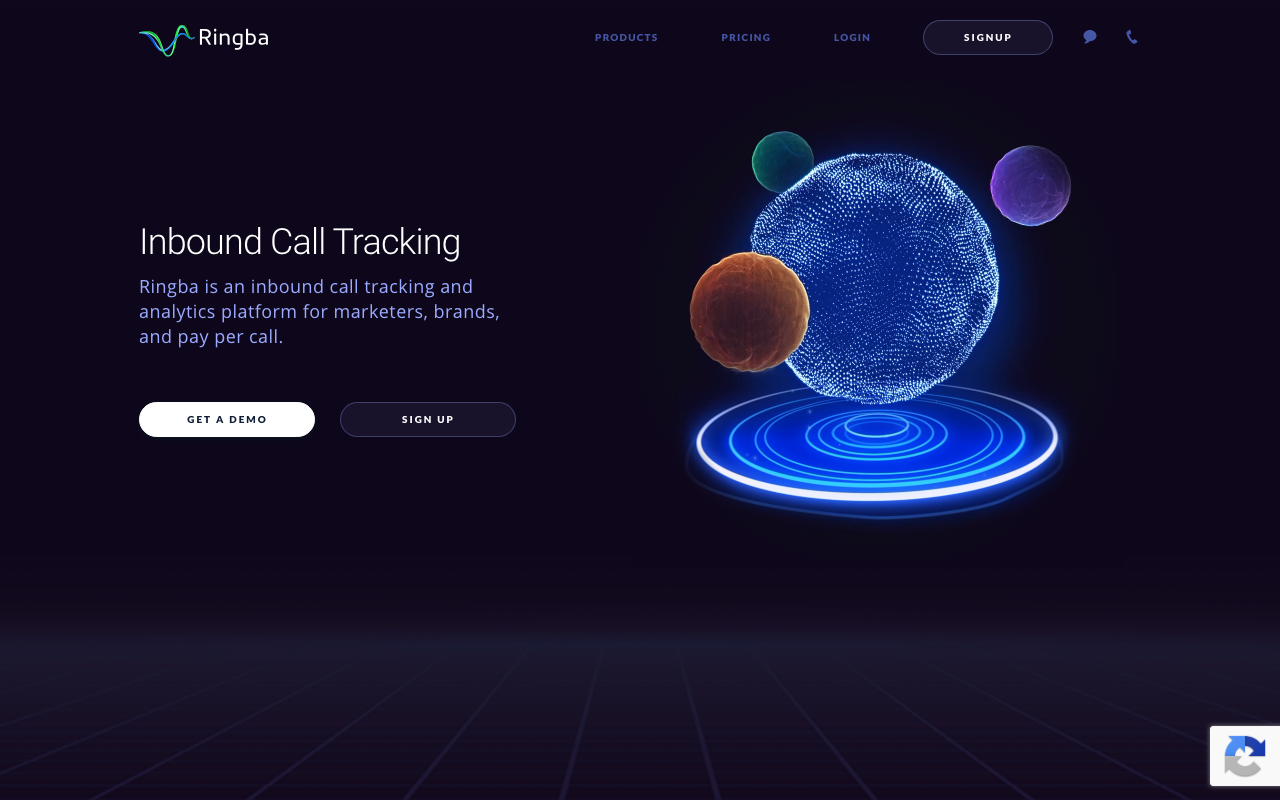
Ringba is the market leader in pure-play pay per call tracking software. It was built exclusively for the pay-per-call industry and shows: the ring tree builder supports conditional routing rules based on caller geography, time of day, IVR keypresses, caller ID reputation scores, and buyer bid prices simultaneously. Agencies managing tens of thousands of calls daily use Ringba's real-time bidding architecture to sell call inventory to the highest-bidding buyer pool without pre-negotiated rates.
The publisher portal is feature-complete. Publishers see revenue by campaign, call duration breakdowns, and hold-time analytics. The platform's call attribution goes down to the sub-ID level, so a publisher running ten traffic sources on the same offer can see which source produced the best connected call rate.
The trade-off is pricing opacity. Ringba's plans are custom-quoted, which makes cost comparison difficult for agencies that are still growing toward high call volume. Ringba also does not handle data leads, which means agencies that monetize both form fills and inbound calls need a second system alongside it.
Pricing: Custom (contact sales). Usage-based call tracking fees apply on top of the platform fee.
Best For: High-volume pay-per-call agencies whose entire business is calls and who need the most advanced ring tree and real-time bidding architecture available.
3. CallRail: Best for Attribution and SMB Call Tracking
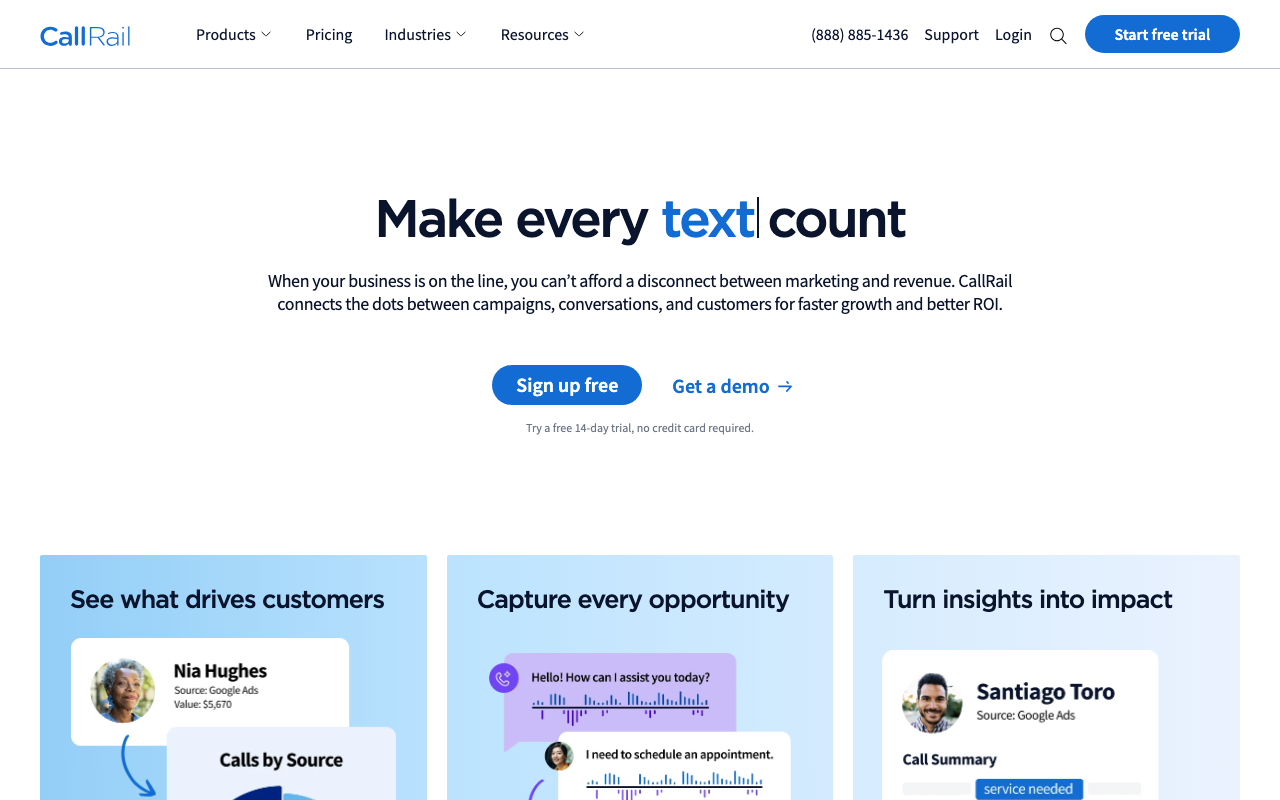
CallRail is the most widely used best call tracking software for small-to-mid-size businesses and agencies focused on marketing attribution. Its dynamic number insertion (DNI) pool correctly attributes calls from Google Ads, Facebook, organic search, and referral traffic, and the conversation intelligence layer transcribes calls and surfaces keywords automatically.
For pay-per-call agency operations specifically, CallRail is missing two critical features. First, it has no publisher portal: publishers cannot log in to view their call volume or payout status. Second, it has no ping-post architecture: call inventory cannot be dynamically auctioned to the highest-bidding buyer pool. These gaps push CallRail firmly into the marketing attribution category rather than the agency call monetization category.
"CallRail is excellent for answering 'which ad drove this call,'" says Rafael Hernandez, Founder and CEO of Lead Distro AI. "But the moment you need to run a publisher-buyer marketplace for call inventory, you are operating beyond what CallRail was built to do."
Pricing: Starts at $45/month for the Call Tracking plan. Usage-based number and minute fees apply. 14-day free trial available.
Best For: Agencies that need granular call attribution and conversation intelligence for their own marketing programs, not for managing pay-per-call publisher networks.
4. CallTrackingMetrics: Best for Agencies Needing Call and Form Tracking with White-Label
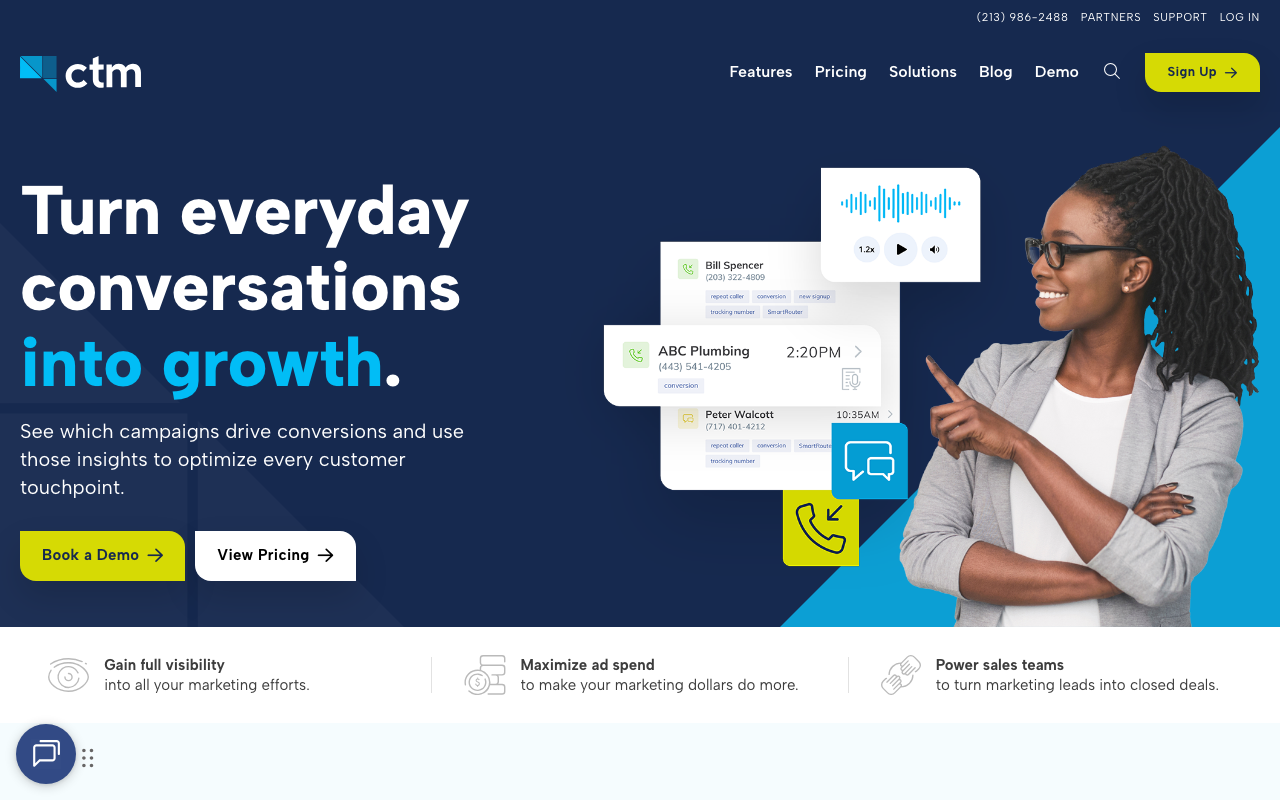
CallTrackingMetrics (CTM) is a conversation analytics platform that tracks calls, form fills, texts, and chats in one place, then layers AI conversation intelligence on top to transcribe and score every interaction. For agencies, its strongest features are the flexible sub-account structure, white-label branding, and custom billing options, which let a marketing agency resell call tracking to clients under its own brand. A built-in softphone and contact center round out the offering for teams that also handle outbound follow-up.
For pay-per-call agency operations specifically, CTM has the same structural gap as CallRail. It has no publisher payout portal where affiliate partners log in to track their own call volume and earnings, and no ping-post auction architecture that routes each call to the highest-bidding buyer pool in real time. CTM is built to attribute calls to marketing campaigns and manage a contact center, not to run a publisher-buyer marketplace. Agencies that monetize affiliate-driven call inventory will still need a distribution layer like Lead Distro AI or Ringba alongside it.
Pricing: Starts at $79/month for the Marketing Lite plan, with Marketing Pro at $179/month and Sales Engage at $329/month. CTM offers the first month free rather than a fixed-length trial. Usage-based per-number and per-minute call fees apply on top.
Best For: Marketing agencies that need call plus form tracking, conversation intelligence, and white-label client reselling, but do not run an affiliate publisher network on a pay-per-call payout model.
5. Phonexa: Best for Enterprise Multi-Channel Pay-Per-Call
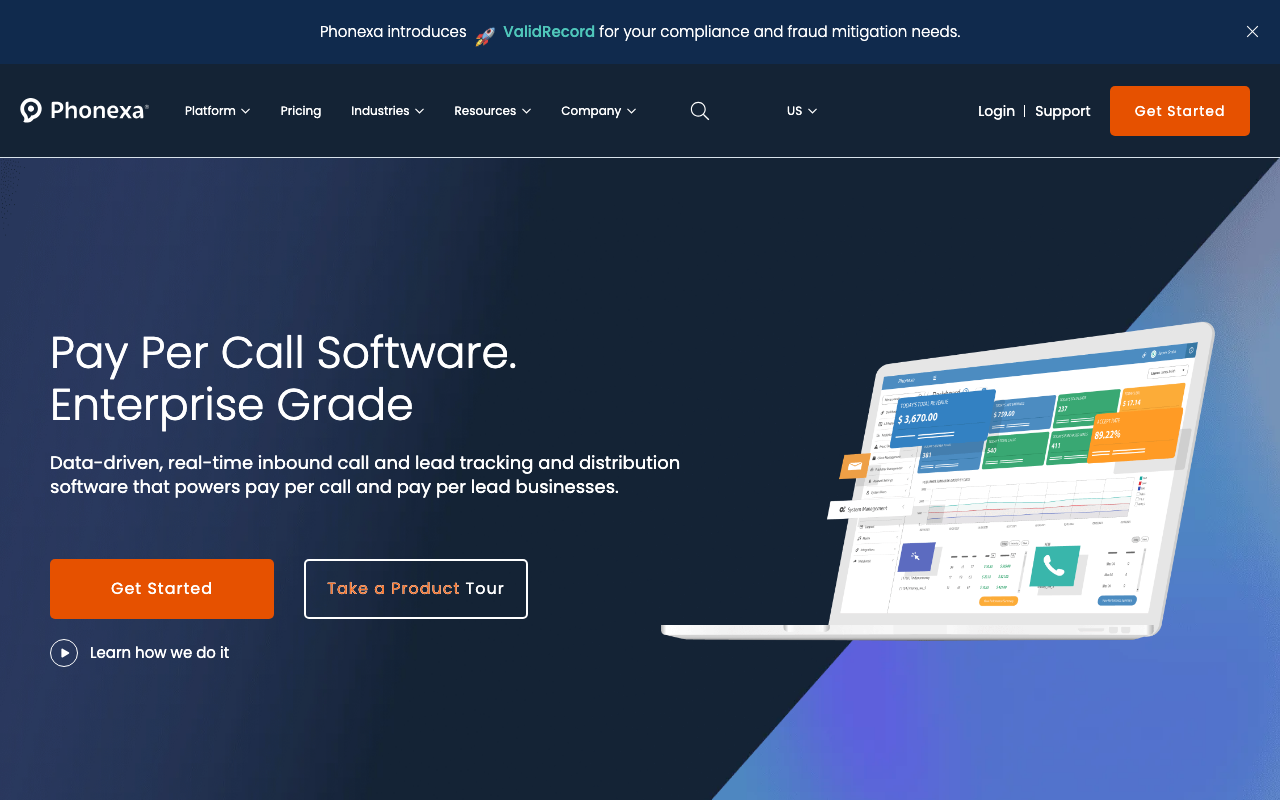
Phonexa is an enterprise performance marketing platform that includes inbound call tracking software as one of eight products (alongside email marketing, accounting, cloud PBX, and more). For pay-per-call agencies at enterprise scale, the all-in-one model reduces vendor count, and the publisher portal supports self-service cap management and payout reporting.
The ring tree builder handles real-time bidding and geographic routing at scale. Phonexa's call attribution layer tracks calls down to the keyword level when paired with its cloud PBX module, which is useful for agencies that also run their own media alongside publisher traffic.
The challenge is onboarding complexity. Each module is sold separately, which means an agency assembling a full pay-per-call stack from Phonexa products faces multiple sales cycles, separate billing, and integration work between modules. Smaller agencies typically find the total cost of ownership higher than a single-platform alternative.
Pricing: Custom (contact sales). Module-by-module pricing means total cost depends on which Phonexa products you bundle. Usage-based call fees apply.
Best For: Enterprise pay-per-call agencies with dedicated operations teams, multi-channel tracking needs beyond calls, and the internal resources to onboard a multi-module platform.
6. Invoca: Best for AI Conversation Intelligence at Enterprise Scale
Invoca's primary strength is AI conversation intelligence: the platform transcribes every call, scores it against custom outcome criteria, and surfaces actionable signals to marketing and sales teams. Enterprises in insurance, financial services, and healthcare use Invoca to connect inbound call outcomes back to Google Ads and Meta campaigns with a precision that standard DNI-only platforms cannot match.
For pay-per-call agencies, Invoca is a partial fit. It handles inbound call attribution and can enforce some call filtering via IVR, but it does not have the publisher portal, ring tree builder, or ping-post auction architecture that agency call monetization requires. The platform is built to help marketers understand call quality, not to run a call distribution marketplace between publishers and buyers.
Pricing: Custom enterprise pricing (contact sales). No self-serve plan. Usage-based call fees apply.
Best For: Enterprise marketing teams and call centers that need deep AI conversation intelligence and call attribution, not pay-per-call agency infrastructure.
What to Look for in Call Tracking Software for Pay-Per-Call Agencies
The evaluation criteria for pay-per-call agencies differ from those for B2B sales teams or local marketing agencies. These five features separate agency-grade platforms from attribution-only tools:
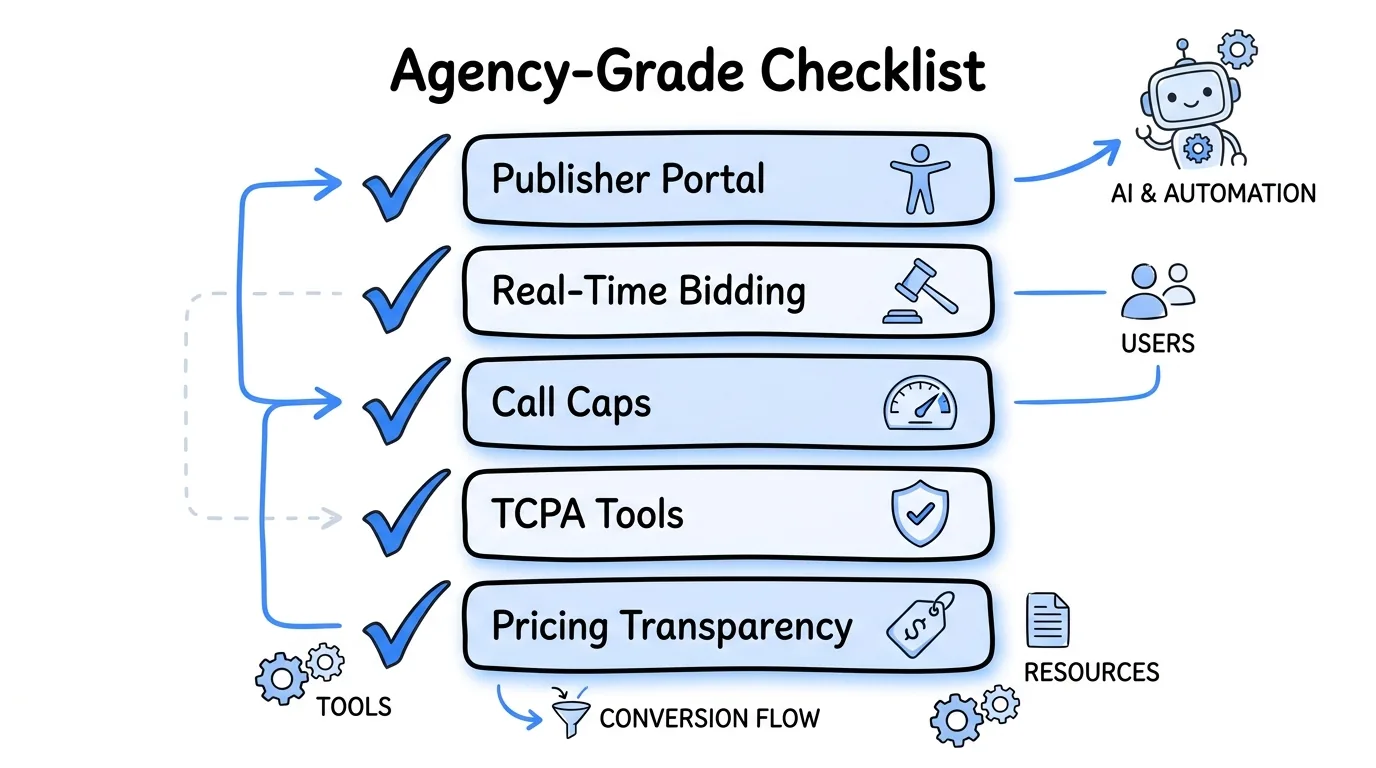
Publisher portal: Publishers need self-service access to their call volume, revenue, hold-time data, and payout history. Without this, your operations team manually answers publisher questions that should resolve themselves. The stakes are higher than admin overhead: Invoca's 2025 analysis found that 35% of businesses never ask leads to buy or book during the call (Invoca, 2025), so a portal that surfaces call recordings and outcomes lets agencies coach buyers off that leak instead of quietly losing payable calls.
Real-time bidding and ping-post: Agency call monetization depends on routing each call to the buyer willing to pay the most at that moment. Platforms without real-time bidding architecture force you into pre-negotiated flat rates.
Call cap management: Buyers set daily and monthly caps. When a cap fills, the platform must reroute the call to the next buyer rather than dropping it. Three-level cap management (publisher, buyer, campaign) is the standard for serious operations. This matters because connection quality is already fragile: Invoca found that only 61% of callers to businesses actually reach a person, meaning 39% of inbound calls never connect to a human (Invoca, 2025). Dropping a capped call instead of rerouting it compounds that loss.
TCPA compliance tooling: TCPA violations carry up to $1,500 per call in statutory damages, and exposure is rising sharply. CompliancePoint counted 2,628 TCPA lawsuits in 2025, a 60% increase over 2024 (CompliancePoint, 2026). Agency-grade platforms reduce that risk with DNC scrubbing, consent verification on inbound numbers, and call time restrictions by state.
Usage-based pricing transparency: Every platform charges per-number monthly fees and per-minute inbound rates on top of the platform subscription. Ask for per-minute rates in writing before signing: at 10,000 minutes per month, a $0.01 per-minute difference equals $100/month in hidden cost.
How Lead Distro AI Handles Call Tracking for Pay-Per-Call Agencies
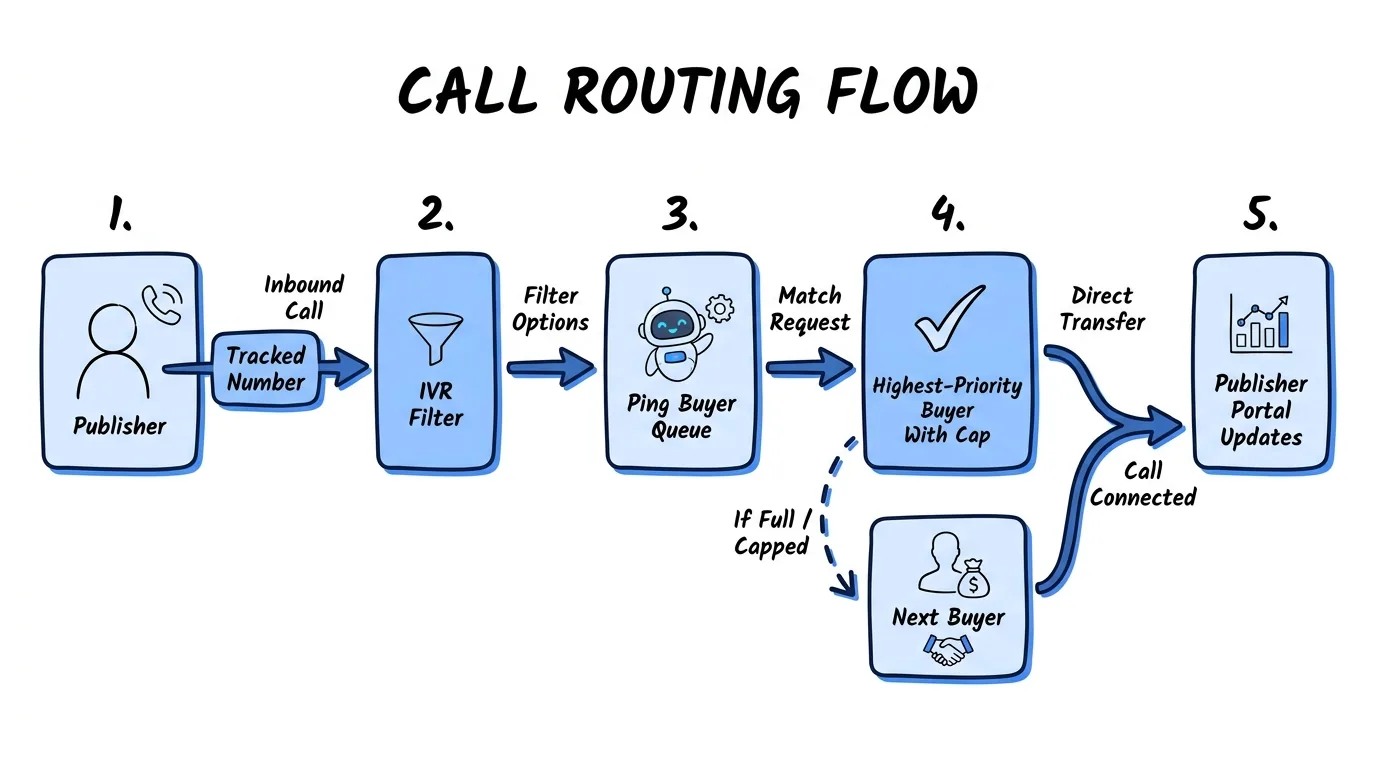
Lead Distro AI was built by a team that ran a pay-per-lead agency before building the software, which shaped the product's architecture. The interactive product tour walks through the full call routing flow, but the high-level mechanics are:
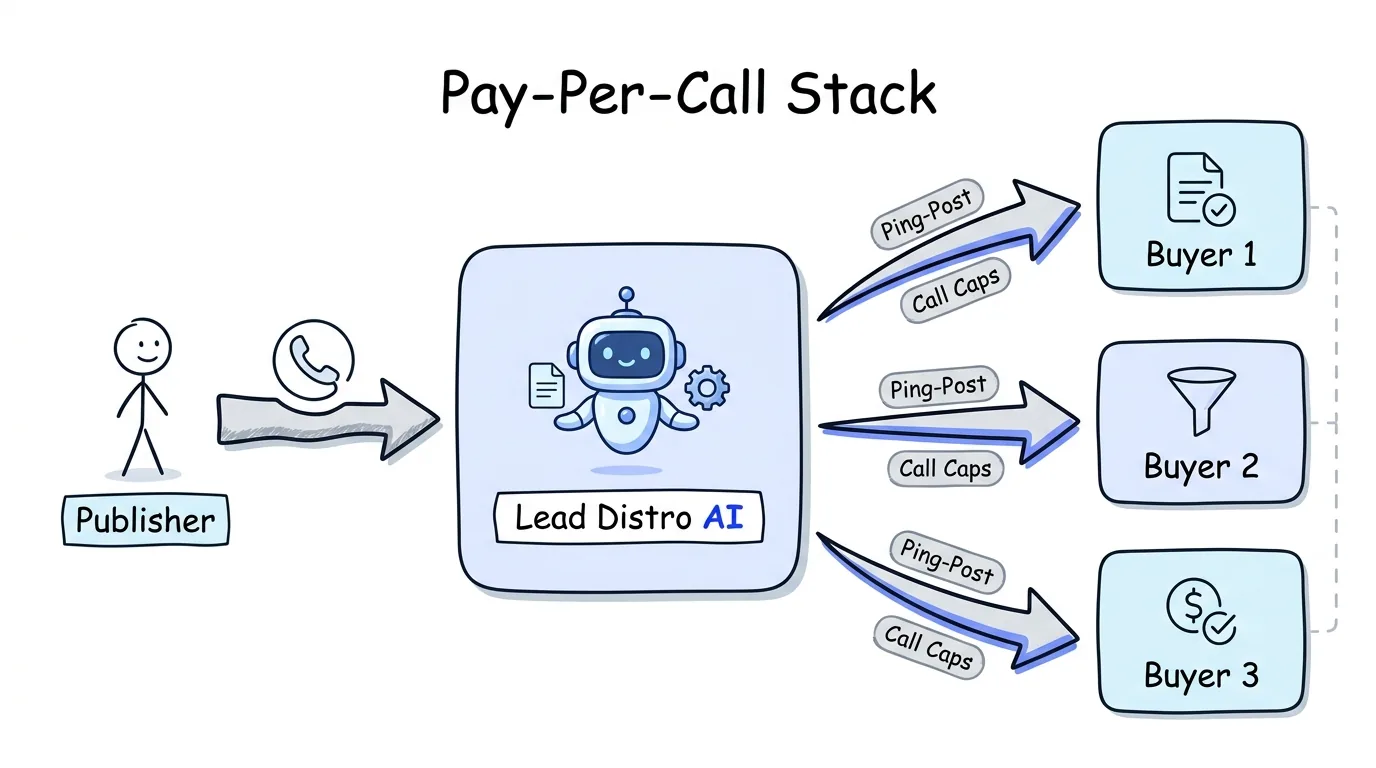
- A publisher drives inbound calls to a tracked phone number provisioned in Lead Distro AI.
- The platform applies IVR filtering based on the campaign's required criteria.
- The call pings the buyer queue, and the highest-priority buyer with available cap receives the live transfer.
- If the first buyer is at cap or unavailable, the call waterfalls to the next buyer in the Priority queue automatically.
- The publisher's portal updates with the call result, duration, and revenue in real time.
For agencies that also distribute data leads, the same buyers and publishers who participate in your call campaigns can participate in your data lead campaigns, all from the same dashboard. That unified view is what separates call tracking software for lead generation from a platform built for agencies managing mixed inventory.
The lead and call distribution software in one platform guide covers the full architecture for agencies that want to understand how call and data workflows intersect.
FAQ
What is call tracking software for pay-per-call agencies?
Call tracking software for pay-per-call agencies is a platform that provisions inbound phone numbers, routes live calls to buyers based on real-time availability and bid price, enforces daily call caps, manages publisher payouts, and provides TCPA compliance tools. It differs from standard call analytics software, which focuses on attribution only. Agency-grade platforms include publisher portals, ring tree routing, and ping-post auction architecture that attribution tools do not offer.
How is call tracking pricing structured for pay-per-call agencies?
Call tracking pricing has two components: a platform subscription fee (flat monthly rate) and usage-based call tracking fees (per-number monthly fee plus per-minute rate for inbound calls). At high call volumes, usage costs often exceed the platform subscription. Always request per-minute rates in writing before signing, and ask whether inbound transfers count as separate billable minutes from the initial inbound leg.
Does Lead Distro AI support pay-per-call agencies specifically?
Yes. Lead Distro AI supports both pay-per-call agencies and pay-per-lead agencies in a single platform. Call routing uses Priority or Weighted distribution methods to waterfall calls across buyer queues, and publisher portals give media partners self-service access to their call performance data. The platform also handles data leads alongside calls, making it the only option on this list for agencies that monetize both traffic types.
What TCPA compliance features should call tracking software include?
Agency-grade call tracking software should include DNC list scrubbing against federal and state lists, consent verification for numbers that require documented opt-in before contact, time-zone-based call restrictions to enforce state-specific calling windows, and call recording disclosure playback for two-party consent states. Some platforms also offer TCPA litigation shield features that log consent data in a format admissible as evidence.
How do Ringba and Lead Distro AI differ for pay-per-call agencies?
Ringba is a pure-play pay-per-call platform with the most advanced ring tree builder and real-time bidding engine on the market. It does not handle data leads. Lead Distro AI is a broader agency platform that handles both call and data lead distribution, with a publisher portal, AI lead scoring, and flat-rate pricing starting at $299/month. Agencies whose entire business is calls often prefer Ringba for its depth. Agencies managing mixed call and data inventory often prefer Lead Distro AI for its unified operations model. For a detailed breakdown, see our guide on Ringba alternatives for pay-per-call.
How does CallTrackingMetrics compare to Lead Distro AI for pay-per-call agencies?
CallTrackingMetrics is a strong call, form, and chat tracking platform with conversation intelligence, a softphone, and white-label sub-accounts that let agencies resell tracking to clients. It starts at $79 per month. What it does not include is a publisher payout portal or ping-post auction routing, so it cannot run a publisher-buyer marketplace for affiliate call inventory. Lead Distro AI is built for that monetization model: it distributes both calls and data leads, gives publishers and buyers self-service portals, and waterfalls calls across buyer queues by priority. Agencies running affiliate-driven pay-per-call campaigns choose Lead Distro AI; agencies that only need attribution and a white-label client dashboard often choose CallTrackingMetrics.
Can call tracking software integrate with affiliate networks and pay-per-call networks?
Most agency-grade call tracking platforms support postback URLs that fire when a call meets a qualifying criterion (minimum duration, connected status, IVR keypress). These postbacks integrate with affiliate networks and pay-per-call networks like Astoria, AroundB, and Palo Media. Lead Distro AI, Ringba, and Phonexa all support configurable postbacks. CallRail, CallTrackingMetrics, and Invoca have limited or attribution-focused postback support because they are not built for affiliate-driven call monetization.
Conclusion
The best call tracking software for pay-per-call agencies in 2026 is Lead Distro AI for agencies managing mixed call and data lead inventory, and Ringba for agencies operating exclusively in the pay-per-call space. Both platforms provide the publisher portals, real-time bidding, and call cap management that agency operations require. CallRail, CallTrackingMetrics, Phonexa, and Invoca serve adjacent needs well but were not built for the publisher-buyer marketplace model that pay-per-call agencies operate.
If you are evaluating your options, the product tour is the fastest way to see whether Lead Distro AI fits your workflow. Start your 7-day free trial and route your first call in under an hour. Credit card required.
For a broader view of pay per call marketing strategy and the full agency growth playbook, that guide covers traffic acquisition, vertical selection, buyer pricing models, and compliance from the ground up. To go deeper on the model itself, see what a pay per call network is and the Lead Distro AI vs Trackdrive comparison.
Ready to see call routing and lead distribution in one platform? Start your 7-day free trial and route your first call in minutes. Credit card required.
About the Author
Founder & CEO of Lead Distro AI & Great Marketing AI
UC Berkeley graduate and former software engineer at Microsoft. Rafael built Lead Distro AI after managing over $10M in ad spend for performance marketing agencies (pay-per-lead and pay-per-call), including running campaigns for Neil Patel. He combines deep software engineering expertise with hands-on performance marketing experience to build tools that help these agencies scale profitably.
About Lead Distro AI
Lead Distro AI: AI-Powered Lead Distribution & Call Tracking That Maximizes ROI
The modern platform for pay-per-lead and pay-per-call agencies. Route, score, and deliver leads with AI-powered automation and real-time P&L tracking. Built for performance marketing agencies and lead buyers across legal, insurance, mortgage, solar, and home services verticals.
4 Distribution Methods
Waterfall, Round Robin, Weighted, Ping-Post
Ping-Post Auctions
Real-time bidding with sub-second routing
Real-Time P&L Reporting
Track revenue, costs, and profit per campaign
Call Tracking
Assign tracking numbers, record calls, and attribute conversions
AI Lead Scoring
Score every lead before routing to maximize conversion
Partner Portal
Self-serve dashboard for buyers to track leads